
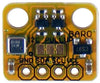
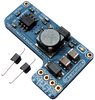
The RGB LED Module is an addressable multi-colour LED that can be daisy-chained into long strings.
Module Pinout
The RGB LED Module has two sets of connections: one for input, and one as output to daisy-chain to other modules.

If you only have a single module, ignore the connections on the left and only use the connections on the right.
VCC: Connect to 5V on your microcontroller (for 5V microcontrollers such as Freetronics Eleven, EtherMega, Arduino Uno, etc.) For 3.3V microcontrollers, connect to 3.3V on your microcontroller.
CKI: Clock Input. Connect to a digital I/O pin on your microcontroller.
SDI: Serial Data Input. Connect to a digital I/O pin on your microcontroller.
GND: Connect to GND (0V) on your microcontroller.
Additional connections for daisy-chaining to other modules:
CKO: Clock Output. Connect to the CKI (Clock Input) on the next module.
SDO: Serial Data Output. Connect to the SDI (Serial Data Input) on the next module.
Basic Connections
Connect GND on the module to GND on your Arduino; VCC on the module to 5V on your Arduino; CKI on the module to one of the digital I/O pins; SDI on the module to another of the digital I/O pins. In this example we used D2 for CKI and D3 for SDI.

Writing and Uploading Sketches
The FTRGBLED library is used for showing colours via the RGBLED. You can download the FTRGBLED library as a zip file.
The zip file will be called “FTRGBLED-master.zip”. When you unzip it, rename the directory from “FTRGBLED-master” to “FTRGBLED”.
Place the FTRGBLED directory inside your Arduino libraries directory. Your libraries directory is usually inside your Arduino “sketchbook” directory, which is usually a directory called “Arduino” inside your documents directory.
If you’re not sure where your sketchbook directory is, you can check (or customise it) under File -> Preferences in the Arduino IDE.
Once you’ve placed the FTRGBLED library directory in place, the structure should look something like "Arduino" -> "libraries" -> "FTRGBLED".
With the library in place, restart the Arduino IDE and look under Files -> Examples. You will see a menu item "FTRGBLED" with the 3 example sketches underneath. Choose an example sketch and then upload it to our board to get started!
For more information about using FTRGBLED, see the README file on github.


